
1967. godine Charles de Gaulle poziva Brigitte Bardot u Élyséejsku palaču.
Supruga ga upozorava: “Charles, nemojte ni pomisliti.”
Prekasno.
An increasing number of Western geopolitical analysts argue that the 21st century will be “Eurasian,” reaffirming Zbigniew Brzezinski’s vision of Eurasia as a “grand chessboard” on which the global balance between the Anglo-American order and competing Eurasian projects—primarily Chinese and Russian—is ultimately determined.
The Anglo-American strategy of fragmenting and rebalancing Eurasia has failed to slow China’s rise or the Belt and Road Initiative (BRI), which seeks to integrate Eurasia into a single economic space with China as its central gravitational pole—precisely the outcome the West has long sought to prevent.
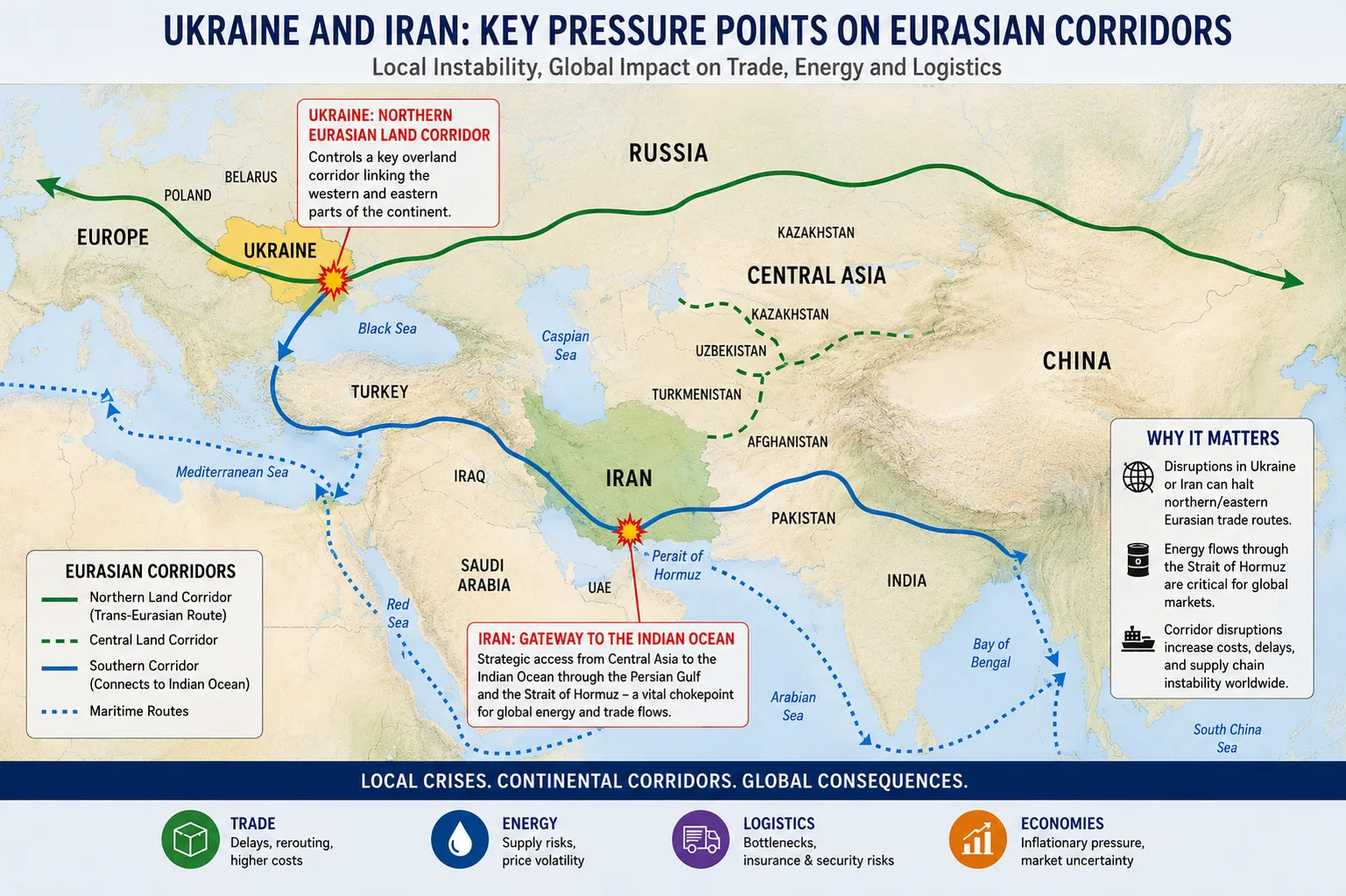
In this context, the war in Ukraine and instability in Iran have become key pressure points along Eurasian corridors: Ukraine controls a critical northern land route, while Iran serves as a strategic gateway from Central Asia to the Indian Ocean. Local crises therefore rapidly escalate into global disruptions of trade, energy, and logistics flows.
Source: AI-generated map, created using OpenAI, 2026.
From this perspective, international relations increasingly take the form of long-term hegemonic competition (“West vs. the Rest”). On one side stands an Anglo-American strategy aimed at maintaining dominance through control of key geopolitical chokepoints and the prevention of Eurasian consolidation; on the other, China’s project of continent-scale infrastructure integration. The result is not a classic bipolar Cold War order, but a fluid and unstable competition in which war, sanctions, and economic integration are simultaneously deployed as instruments of power.
Russia no longer retains the level of influence it gained through its intervention in Syria, and the war in Ukraine has further constrained its capacity to shape developments in the Middle East. The region is therefore best understood through the prism of Sino-American rivalry rather than a purely U.S.–Russia dynamic. Although Iran, Saudi Arabia, and Israel remain major regional powers, the United States continues to exercise structural dominance through its control of the security architecture, energy flows, and key maritime routes, seeking to preserve the balance of power and prevent the emergence of a regional hegemon amid deepening Eurasian integration.
As a result, Western political discourse is increasingly shaped by concerns over the asymmetric distribution of security burdens within the Atlantic alliance. A frequently cited example is German Chancellor Friedrich Merz’s remark during recent escalations: “Israel is doing the dirty work for all of us.” This reflects the perception that Israel undertakes the most operationally risky security tasks within the broader strategic confrontation between the “West and the Rest.” It also helps explain continued European political support for Israel, even in cases where its actions diverge from international law and human rights norms.
In a similar vein, just as Volodymyr Zelensky in Ukraine confronts Russia, Benjamin Netanyahu in the Middle East has assumed a role of “doing the dirty work” on behalf of the wider West. However, this role carries long-term consequences that are difficult to fully anticipate for the stability of the states and political systems involved. In return, these actors expect sustained financial, military, and political backing from the West, which seeks to preserve its global dominance.
Yet such expectations are increasingly problematic in the long term. Both the United States and European countries aim to minimize the costs of these commitments—financial and human alike—and to ensure that sanctions and military pressure weigh more heavily on adversary economies than on their own. As this balance is not always achievable in practice, it is plausible that at certain points these partners may find themselves without full and unconditional support.
History has already demonstrated similar patterns with Western-backed local regimes (South Vietnam, Afghanistan, Iraq, Kurdish forces).
In this sense, the “War for Eurasia” is not merely a confrontation between great powers, but also a question of the limits of Western power projection in an increasingly multipolar, multivector, and strategically independent world.